Apr. 27, 2026
On April 25, "Merchants Across the World"—a six-part major documentary produced by the Finance and Economics Program Center of China Media Group (CMG)—premiered on the CCTV-2 Finance Channel during its 10:00 PM time slot. The cameras ventured deep into numerous countries and regions across the globe, offering a panoramic chronicle of the resolute strides taken by Chinese enterprises as they "go global." Notably, FAWDE—standing as a benchmark exemplar of Chinese commercial vehicles setting sail for international markets—featured prominently in the series' first episode, "The Rising Tide", appearing as the inaugural representative case study. Through the lens of the camera, FAW Group—drawing upon over seventy years of accumulated craftsmanship and a pioneering journey of deep cultivation in South Africa—vividly demonstrated the formidable brand appeal of Chinese automotive marques as they make their debut on the world stage.

Harris Modley: "My name is Harris Modley, and I have been with FAW South Africa for thirty-one years."
Thirty-one years ago, when FAW Group first arrived in South Africa—the nation situated at the southernmost tip of the African continent—Harris was the very first local employee hired by FAW South Africa.
His most critical task at the moment involves inspecting a new vehicle: the latest generation of heavy-duty tractor trucks, poised for imminent launch in the South African market.

The headquarters of FAW South Africa is located in Johannesburg, the country's largest city.
A company-wide service provider meeting—held once every six weeks—is currently underway at the headquarters. Managers from 33 service providers gather regularly to exchange insights on after-sales issues, market trends, and policy adjustments. In the hallway just outside the conference room, a display board features a few simple figures—numbers that quietly chronicle the arduous journey undertaken by this Chinese enterprise as it ventured into the global arena.
Huang Xin (Executive Deputy General Manager, FAW South Africa): "This chart traces the history of FAWDE: from the establishment of our factory in 1953, through the rollout of our first 'FAWDE' truck in 1956, all the way to the present day—spanning seven generations of products. This specific vehicle here represents our very first export to South Africa—the second-generation FAWDE truck."
That was in 1994. Nelson Mandela had just been elected as the first president of the "New South Africa," and FAW's second-generation truck entered the South African market through the export of fully assembled vehicles. Huang Xin: "At that time, Chinese products held no reputation globally; only European and Japanese products were being marketed internationally overseas."

At that time, China FAW bore the heavy responsibility of spearheading the rise of the nation's industrial sector, while also facing the practical imperative to generate foreign currency revenue. Within the entire overseas market of that era, FAWDE trucks stood as one of the few heavy industrial products from China to be exported on a significant scale.
Huang Xin: "It was incredibly difficult back then. At that time, no one even knew that China was capable of manufacturing automobiles—let alone exporting them."
This is an ordinary highway in Johannesburg; even during off-peak hours, the traffic remains dense. As early as the 1980s—when China was just embarking on its Reform and Opening-up era—South Africa already boasted a highly developed and comprehensive highway network.
As the wealthiest nation on the African continent, South Africa of that era possessed Africa's largest automotive consumer market. Global automotive giants vied fiercely for dominance in this arena, and FAW, having just entered the South African market, found its initial progress arduous.

Huang Xin: "When we first entered this market in 1994, we were only able to export 50 vehicles per year."
During this period, China's automotive industry relied primarily on joint ventures, while private domestic automakers were just beginning to emerge. From 1994 to 2003—a span of a full decade—annual sales figures barely managed to surpass 100 units. Another ten years passed, and by 2014, sales had only just managed to scrape past the 600-unit mark. The question remained: how could the company transition from the arduous struggle of pioneering a new market to firmly taking root and flourishing? Upon reaching its 20th anniversary in South Africa, FAW made a decisive move: it decided to construct a local manufacturing plant.

In 2014, an assembly plant was established in the very birthplace of Nelson Mandela.
Rassie Erasmus (Production Manager, FAW South Africa—Coega Plant): "Good afternoon, everyone. Welcome to the FAW plant."
European brands positioned themselves at the premium end of the market, yet came with steep price tags; Japanese brands offered lower prices, but often at the cost of lower specifications. If a manufacturer could successfully deliver high specifications at an affordable price point, it would undoubtedly provide a massive boost to its competitiveness within the market.
Fast-forward to 2022: following its accession to the World Trade Organization, China embarked upon a "golden era" spanning two decades. During this period, numerous Chinese enterprises successfully completed their global strategic layouts through a combination of overseas investment, mergers and acquisitions, and the establishment of manufacturing facilities abroad.
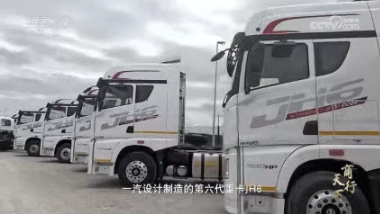
The Chinese automotive industry has successfully achieved a triple leap forward: establishing an independent industrial chain, securing a cost advantage, and reaching the pinnacle of technological innovation. Its heavy-duty truck technology now ranks among the global elite; specifically, the sixth-generation JH6 heavy-duty truck—designed and manufactured by FAW—has entered the South African market, where it has established a formidable competitive presence.
Huang Xin: "It perfectly meets the market demand of our South African customers, who seek both high-end configurations and a strong emphasis on economic efficiency."

In overseas markets, after-sales service is another critical factor determining success or failure. However, establishing a comprehensive after-sales system is both capital-intensive and time-consuming—conditions that many Chinese enterprises venturing abroad in earlier years simply did not possess.
Huang Xin: "Many Chinese companies that initially ventured out were primarily trade-oriented enterprises. They would import the vehicles, but failed to bring along the corresponding service infrastructure or administrative support systems. Consequently, throughout much of this history, while many Chinese automakers struggled to gain a foothold abroad, Chinese *dealers* did manage to establish a presence. Yet, these dealers focused solely on selling cars, without giving adequate consideration to the service requirements that arise *after* the vehicles are put into use."

This facility, located in Johannesburg, serves as the central spare parts warehouse, housing over 15,000 different types of components. Additionally, two regional sub-centers have been established in Durban—South Africa’s second-largest city—and Cape Town, its third-largest. These three spare parts depots are interconnected with a network of 33 dealerships, forming a comprehensive service network that effectively covers the entirety of South Africa.
Driven by exceptional value for money combined with reliable after-sales support, FAWDE Trucks—after thirty years of deep-rooted engagement in South Africa—successfully captured the top spot in market share in 2024. Over these three decades, an increasing number of Chinese automotive enterprises have established a presence in South Africa, utilizing the country as a strategic bridgehead to aggressively expand their reach across the broader African market.
In November 2025, when South Africa hosted the G20 Summit, several Chinese automotive models were selected as official vehicles for the event, serving as a shining showcase for Chinese automobiles as they make their mark on the global stage.
Shortly after the New Year in 2026, a shipment of 100 brand-new J7 heavy-duty tractor units was loaded onto a vessel at the Port of Tianjin. Setting sail from the Bohai Bay, these trucks will traverse the Indian Ocean, arriving in South Africa just 30 days later. From the northeastern corner of China to the Cape of Good Hope at the edge of the world—as we cast our gaze across the global map and examine this specific coordinate at Africa’s southern tip—it emerges as far more than a mere geographical entity; it stands, rather, as a cultural symbol. It serves as a reminder of the opportunities and responsibilities inherent in trade, while also embodying our courage to explore the unknown and our vision of a globally interconnected world.
Related News
Volvo CE and FAWDE Launch Global Cooperation Project
Sep. 29, 2025
Good News! Engine Division Wins First Month’s Open Doors
Feb. 05, 2021
Obtained Euro Ⅵ-e Emission Certification, Jiefang Power And Boosting Global Voice Of China Power
Feb. 05, 2021
Chúng Tôi Sẽ Dành Này Tết Nguyên Đán Ở Nước Ngoài
Feb. 09, 2021
Why? Emancipation Power Promotes Global Discourse Power Of China Power!
Feb. 26, 2021
Apr. 23, 2021
Related Products

Type: 6-cylinder in-line, direct injection, turbocharged&intercooling, common rail

Type: 6-cylinder in-line, direct injection, turbocharged&intercooling, common rail

Self-developed Common Rail + Elimination of Post-treatment
Type: 6-cylinder in-line, direct injection, turbocharged&intercooling, common rail

Contact Us
Navigation
Navigation


 FR
FR
 ES
ES
 VN
VN
 AR
AR
 RU
RU
